
Court Orders Company to Fund Restoration Efforts Until Fragile Coastal Ecosystem Recovers
Kutch Marine Sanctuary: In a landmark judgment with significant implications for environmental protection in India, the Gujarat High Court has held Tata Chemicals Limited (TCL) responsible for ecological damage caused to the Kutch marine sanctuary and directed the company to bear the cost of restoring the affected ecosystem.
The court ruled that the company would remain financially liable for environmental restoration until the damaged marine habitat is fully rehabilitated and pollution levels are brought under control. The decision follows a prolonged legal battle over industrial effluent discharge from Tata Chemicals’ manufacturing facility in Mithapur, located in Gujarat’s Devbhumi Dwarka district.
The judgment is being viewed as one of the most consequential rulings concerning industrial pollution in protected coastal areas and reinforces the application of the “Polluter Pays” principle under Indian environmental law.
A Significant Verdict for Coastal Conservation
The ruling was delivered by a division bench comprising Chief Justice Sunita Agarwal and Justice D.N. Ray. The court dismissed a petition filed by Tata Chemicals, which had challenged government decisions denying the company the right to continue discharging treated industrial wastewater into an area later designated as part of a protected marine ecosystem.
The bench found that the company had no legal entitlement to release industrial effluents into land and coastal zones notified as protected areas under government regulations.
According to the court, the company’s argument that it had been using the discharge route since the 1960s could not override environmental protections introduced after the area was declared part of a Marine National Park and Marine Sanctuary.
The judges observed that industrial activity cannot continue indefinitely merely because it existed before environmental safeguards were enacted. Once an area gains legal protection, all activities within it must comply with the applicable environmental and conservation laws.
Decades-Long Dispute Over Industrial Wastewater Disposal
The dispute revolves around Tata Chemicals’ industrial complex at Mithapur, one of the oldest chemical manufacturing facilities in western India.
Established in 1939, the plant produces several industrial and consumer products, including:
Table salt
Soda ash
Cement
Sodium bicarbonate
Bromine
Caustic soda
Light soda ash
For decades, wastewater generated by the plant was discharged through surrounding coastal areas. The company argued that these disposal practices had existed long before the government declared parts of the Gulf of Kutch region as environmentally protected zones.
However, environmental regulations evolved significantly over time. Large sections of the coastline surrounding the facility were notified as protected marine habitats during the 1980s.
The legal dispute emerged when authorities and environmental groups questioned whether the company could continue using these areas for wastewater disposal after the protection status came into effect.
Importance of the Kutch Marine Sanctuary
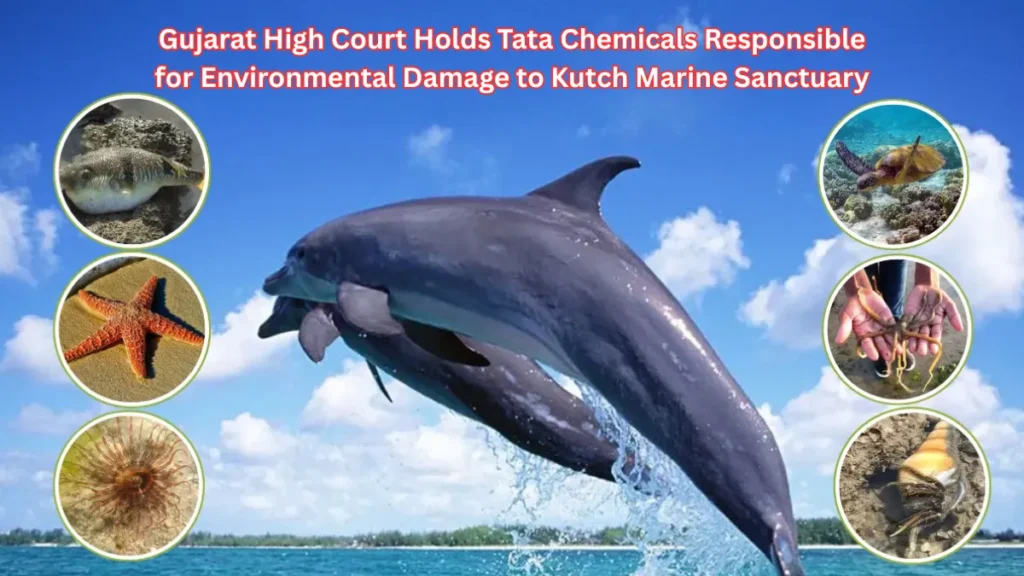
The Kutch marine sanctuary is among India’s most ecologically important coastal regions. Located within the Gulf of Kutch along Gujarat’s western coastline, the sanctuary supports a rich variety of marine and coastal biodiversity.
The protected ecosystem includes:
Coral reefs
Mangrove forests
Mudflats
Intertidal zones
Seagrass habitats
Breeding grounds for fish and marine species
The sanctuary is also home to numerous migratory birds, crustaceans, mollusks, marine mammals, reptiles, and commercially important fish species.
Environmental experts have long emphasized that these ecosystems serve as natural buffers against coastal erosion, support local fisheries, and contribute significantly to the livelihoods of fishing communities living around the Gulf of Kutch.
Because of its ecological significance, the region enjoys legal protection under various environmental and wildlife conservation laws.
Court Rejects Company’s Claim of Historical Rights
A central argument advanced by Tata Chemicals was that it possessed “existing rights” to continue discharging wastewater because the practice predated the sanctuary’s creation.
The Gujarat High Court firmly rejected this claim.
The bench held that historical usage does not automatically create perpetual rights when the activity conflicts with environmental protection laws enacted later.
The court noted that district authorities had repeatedly rejected the company’s claims and had found no legal basis for allowing continued discharge into the protected area.
According to the judgment, government authorities had examined the issue multiple times and consistently concluded that the company lacked any legal entitlement to use sanctuary land for industrial wastewater disposal.
As a result, the court upheld the decisions taken by the district administration and refused to recognize the company’s asserted rights.
Encroachment into Protected Government Land
One of the most serious findings highlighted in the judgment concerns the gradual expansion of industrial wastewater discharge into protected government land.
Evidence examined during the proceedings indicated that effluent was initially confined to land owned by the company.
Over time, however, wastewater spread beyond the company’s property boundaries and entered adjacent coastal areas falling within the marine sanctuary.
The court referred to findings that more than 100 hectares of government land had eventually become affected by wastewater accumulation and associated environmental impacts.
Authorities concluded that the company had progressively encroached upon protected coastal areas through its disposal practices.
The judges accepted these findings and observed that the company had no legal authority to use sanctuary land as a wastewater disposal zone.
Environmental Damage Described as Severe
The judgment contains strong observations regarding the environmental consequences of the company’s actions.
According to the court, continued discharge of industrial effluent caused significant degradation of a fragile ecological zone.
The affected area reportedly suffered damage to its natural habitats, biodiversity, and environmental characteristics over an extended period.
Court records indicate that authorities documented impacts on:
Coastal ecosystems
Flora and vegetation
Wildlife habitats
Marine biodiversity
Geological and geomorphological features
Natural ecological processes
The judgment references concerns that portions of the sanctuary had effectively been transformed into what environmental assessments described as a “black desert” due to prolonged pollution and industrial waste accumulation.
Such observations underscore the court’s view that the environmental harm extended beyond isolated pollution incidents and represented a broader degradation of a protected ecosystem.
Failure to Obtain Required Environmental Clearances
Another major factor influencing the court’s decision was the absence of necessary statutory approvals.
The court found that the company had not secured forest clearances or coastal regulation approvals required for activities within or affecting protected coastal zones.
Environmental laws governing forest land and coastal ecosystems impose strict requirements on industries operating near sensitive habitats.
The judgment noted that despite repeated rejections of its claims by district authorities, the company continued asserting its right to discharge wastewater into the protected area.
The court concluded that such activities proceeded without the legal authorizations necessary for operating within an environmentally sensitive region.
This finding further strengthened the court’s determination that the company’s actions were unlawful.
Pollution Control Board Directed to Assess Damages
A key outcome of the judgment is the direction issued to the Gujarat Pollution Control Board (GPCB).
The court instructed the pollution control authority to undertake a comprehensive assessment of ecological damage caused by the industrial discharge.
The GPCB has been directed to:
Evaluate environmental losses.
Quantify ecological damage.
Determine restoration costs.
Calculate compensation payable by the company.
The board has been given a three-month deadline to complete this exercise and submit its findings.
Environmental experts believe that calculating damage in coastal ecosystems can be challenging because ecological impacts often persist for years and affect multiple interconnected habitats.
The final compensation figure may therefore depend on extensive scientific studies and restoration assessments.
Polluter Pays Principle Reaffirmed
The judgment strongly reinforces one of the most important doctrines in environmental law—the Polluter Pays Principle.
Under this principle, entities responsible for environmental harm must bear the costs associated with repairing and restoring damaged ecosystems.
The court emphasized that industries cannot shift the burden of environmental recovery onto governments, local communities, or taxpayers.
Instead, those responsible for pollution must finance restoration measures necessary to return ecosystems to a healthy state.
By applying this principle, the court sought to ensure accountability for environmental damage while creating a financial incentive for industries to adopt cleaner and more sustainable practices.
Legal experts note that the ruling aligns with several landmark environmental judgments delivered by Indian courts over the past few decades.
Continuing Liability Until Restoration Is Complete
Perhaps the most significant aspect of the ruling is the concept of continuing liability.
Rather than imposing a one-time penalty, the court stated that Tata Chemicals would remain responsible for compensation and restoration efforts until ecological recovery is achieved.
This means the company’s obligations will not end merely after paying an initial compensation amount.
Instead, responsibility will continue as long as environmental damage remains unresolved.
The judges clarified that restoration must continue until the affected area becomes pollution-free and the ecological balance of the marine sanctuary is restored.
Environmental lawyers describe this as a powerful mechanism because ecological recovery in marine environments often takes many years.
By linking liability to restoration outcomes rather than a fixed payment, the judgment places long-term responsibility on the polluter.
Authorities Ordered to Prevent Further Pollution
The court also addressed concerns about ongoing environmental risks.
Government agencies and local authorities were directed to take stringent action to prevent any further pollution from affecting the sanctuary.
The judgment emphasized the need for immediate measures to stop continued environmental degradation.
Authorities have been instructed to closely monitor compliance and ensure that industrial operations meet prescribed environmental standards.
The court also indicated that stronger regulatory interventions may be necessary if pollution persists.
These directions underscore the judiciary’s expectation that enforcement agencies must play a proactive role in protecting sensitive ecosystems.
Deep-Sea Pipeline Project Under Scrutiny
The ruling refers to efforts by the company to transition toward a deep-sea wastewater disposal system involving closed pipelines and diffuser technology.
According to information discussed during the proceedings, updated wastewater standards for soda ash manufacturing units were introduced by the Ministry of Environment and Forests in 2011.
The court observed that despite these revised standards, it took approximately fifteen years for the company to establish the necessary infrastructure for compliance.
Questions regarding the effectiveness and regulatory compliance of the new disposal system remain subject to oversight by authorities.
The court indicated that industrial operations may face stricter consequences if the system fails to meet environmental requirements.
Local Communities Welcome the Decision
The judgment has been welcomed by several environmental groups and community representatives who have long raised concerns about pollution in the region.
Activists argue that communities living around the Mithapur industrial zone have experienced environmental impacts for decades.
Local residents, including farmers, pastoralists, and traditional fishing communities, have repeatedly alleged that pollution affected natural resources upon which their livelihoods depend.
Environmental organizations say the court’s decision recognizes these concerns and provides a pathway toward accountability and ecological restoration.
Many activists believe the ruling could strengthen public confidence in environmental governance and encourage more rigorous enforcement of pollution control laws.
Origins of the Case
The legal battle traces its roots to multiple proceedings spanning nearly four decades.
In the late 1980s, Tata Chemicals challenged restrictions related to wastewater discharge after portions of the surrounding area received protected status.
Subsequent disputes continued through various legal and administrative forums.
A major chapter unfolded in 2006 when the company filed a petition seeking recognition of its claimed rights to discharge industrial wastewater through approximately 200 hectares of coastal land.
District authorities rejected those claims, leading to further litigation.
The case gained renewed attention after residents and environmental advocates highlighted allegations of continued pollution and inadequate regulatory enforcement.
These concerns ultimately contributed to the broader scrutiny that culminated in the recent High Court judgment.
Broader Implications for Industrial Development
The ruling is likely to have implications beyond a single company or location.
India’s rapid industrial growth frequently intersects with environmentally sensitive areas, creating tensions between economic development and ecological conservation.
Courts increasingly face the challenge of balancing industrial activity with constitutional obligations to protect natural resources.
The Gujarat High Court’s decision sends a clear message that environmental compliance cannot be treated as a secondary consideration.
Industries operating near forests, wetlands, coastal zones, and wildlife habitats may face closer scrutiny regarding historical practices that conflict with modern environmental laws.
The judgment also highlights the importance of obtaining statutory clearances and maintaining compliance throughout the life cycle of industrial projects.
Also read: Yuvraj Singh Linked With Delhi Capitals Coaching Role as IPL 2027 Transfer Rumours Gather Pace
Future of the Kutch Marine Sanctuary
The future of the Kutch marine sanctuary will depend largely on the effectiveness of restoration measures and regulatory oversight in the coming years.
Environmental scientists note that coastal ecosystems possess remarkable resilience when protected from continued stress. However, recovery often requires sustained monitoring, habitat restoration, pollution control, and community participation.
The court’s emphasis on continuing compensation reflects recognition that ecological restoration is not an overnight process.
Restoring damaged intertidal habitats, improving water quality, rebuilding biodiversity, and protecting sensitive marine species may require long-term commitment from both regulators and industry.
For conservationists, the judgment represents an opportunity to strengthen protection of one of India’s most valuable marine ecosystems. For industries, it serves as a reminder that environmental responsibilities extend beyond production targets and profit margins.
As authorities begin assessing damages and planning restoration strategies, the decision is expected to remain a significant reference point in future environmental cases involving protected coastal regions across the country.